
Yamywyh
Global sourcing is changing how architects and buyers evaluate façade materials. Glareless Glass offers a practical response to harsh reflections, screen glare, and uneven daylight. It can support comfortable interiors in offices, schools, retail spaces, and transport buildings. The best choice depends on more than appearance.
Performance must be checked carefully. Buyers should review visible light transmission, solar control, haze, color consistency, coating durability, and safety documentation. A small sample near a sunlit window can reveal issues that a product brochure hides. Reflections may change during the day. That matters.
Dr. Helen Sanders, a recognized building-envelope specialist, states, “Glare control is not about making glass dark; it is about making daylight usable.” Her point is valuable for international procurement. A darker pane may reduce brightness, but it can also create gloomy rooms and higher lighting demand. Glareless Glass should balance visual comfort, natural light, energy performance, and long-term maintenance.
Reliable sourcing also requires clear communication. Suppliers should provide tested specifications, batch records, installation guidance, and realistic lead times. Buyers need to confirm whether the coating suits the frame, climate, cleaning method, and building orientation. Regional standards can differ, so documentation deserves close review.
There is no perfect glazing product. That is easy to forget. A solution that works beside a north-facing window may fail on a western façade. Careful sampling, independent verification, and honest performance comparisons create stronger purchasing decisions. For global buyers, Glareless Glass becomes valuable when its comfort benefits are proven, not merely promised.
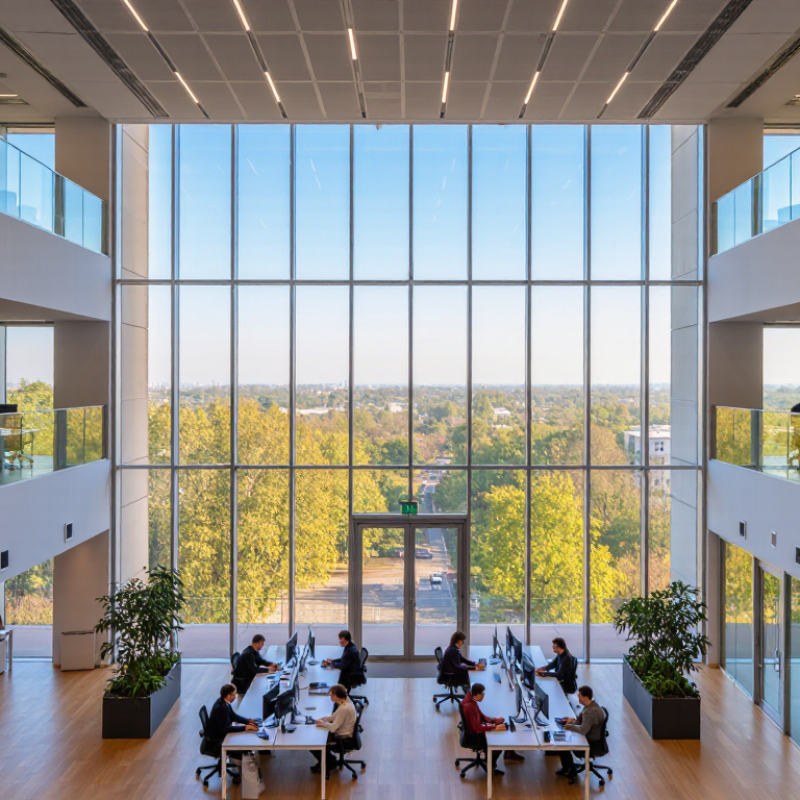
Glareless glass is designed to reduce harsh reflections from light sources, screens, and bright surroundings. It usually uses a finely etched surface or a controlled anti-reflective coating. These treatments scatter or redirect reflected light instead of sending one sharp image toward the viewer. The result is a softer viewing experience, especially near windows, overhead lamps, or outdoor displays. The glass still transmits light, but its surface becomes less mirror-like.
The effect depends on surface texture, lighting direction, viewing distance, and glass thickness. A useful sourcing process compares haze, gloss, light transmission, reflectance, and color neutrality.
Suppliers should provide technical data and physical samples under realistic lighting. Test the sample beside a window. Then test it under artificial light. It may perform differently.
Higher diffusion can reduce glare, but it may also soften fine details or create a slightly cloudy appearance. Cleaning methods matter too, because fingerprints can become more visible on textured surfaces.
No option removes glare from every angle. That limitation deserves honest discussion before purchasing.
Buyers should confirm dimensions, edge quality, packaging, inspection procedures, and required performance standards before approving a global order. A small sample review often reveals problems that drawings cannot show.

Glareless glass is most valuable where people must read screens under changing light. It reduces distracting reflections from windows, ceiling panels, and task lamps. This matters in hospital wards, diagnostic rooms, and pharmacies, where small interface details affect daily work. Nurses may read medication records beside a bright window. Technicians may inspect imaging controls during long shifts. A low-reflection surface can support comfort and consistent viewing. It does not replace proper lighting design. The setting matters.
Education benefits too. In classrooms and laboratories, students view interactive displays from different angles. Glareless glass can make diagrams, formulas, and live demonstrations easier to follow. Offices with glass façades face a similar problem. Meeting-room displays often mirror sunlight at the worst moment. Anti-glare treatment helps when screens remain visible across a wide table. However, excessive diffusion may soften fine text or reduce perceived contrast. That trade-off deserves testing before large-scale sourcing.
Retail, transport, and public information systems also use it. A self-service kiosk near an entrance may receive direct afternoon sun. A ticketing screen must remain readable through fingerprints, repeated cleaning, and constant touch. Buyers should verify haze, light transmission, scratch resistance, touch response, and cleaning compatibility with sample panels. Field trials are more reliable than catalog figures alone. Test it early. Glareless glass is not a universal fix. Its value depends on the display, lighting, viewing distance, and maintenance routine.
Why Choose Glareless Glass for Global Sourcing?
Glareless glass can improve visual comfort in offices, retail spaces, museums, and transportation facilities. For global buyers, appearance is only one quality indicator. Start with measurable optical data. Request visible light transmittance, haze, reflectance, and color consistency results. These values should be tested under clearly stated methods. A showroom sample may look excellent. Large panels can reveal uneven diffusion, cloudy areas, or color shifts.
Durability requires equal attention. Ask how the surface performs after abrasion, humidity, ultraviolet exposure, and thermal cycling. Coating adhesion matters when glare control depends on a surface layer. Etched surfaces need checks for scratches, pinholes, stains, and cleaning resistance. Confirm thickness tolerance, flatness, edge quality, and panel dimensions. International standards such as EN 1096 or relevant ASTM methods may guide testing, but buyers should match them with project requirements. A certificate alone is not enough.
Reliable sourcing also depends on traceability. Request batch numbers, inspection records, production dates, and packaging details. Compare a pre-production sample with the final shipment under similar lighting. I have found that small differences become obvious beside white walls or digital screens. One uncomfortable truth: a perfect sample does not guarantee stable mass production. Ask for independent inspection when the order is large. Review the supplier’s corrective-action process, too. It may seem excessive, yet weak responses often reveal deeper quality problems. My own preference is clear acceptance limits, documented retesting, and photographs from several production stages. Erotiske
Glareless glass can make international sourcing more predictable when visibility matters. It reduces harsh reflections from sunlight, lamps, and digital screens. This supports displays, showroom windows, control panels, and architectural interiors. Buyers can compare products more accurately when glare, haze, and color shift are measured separately. A clear technical sheet should state transmission, reflection, surface treatment, thickness, and tolerance levels. Small differences matter.
Tips: Request samples before approving a bulk order. Examine them under daylight and strong indoor lighting. Check viewing angles, fingerprints, cleaning marks, and edge quality. Ask for recent test reports from qualified laboratories. Requirements may differ between countries, so confirm applicable safety and performance standards before shipment.
International suppliers also benefit from consistent packing and traceable production records. Protective film, corner guards, moisture control, and shock-resistant crates can reduce transit damage. Packaging should match the route, not just the product. A supplier’s communication process matters too. Confirm sampling dates, inspection points, lead times, replacement procedures, and export documents in writing. Glareless performance is not always permanent; cleaning chemicals, abrasion, and installation errors can affect the surface. This is where sourcing plans sometimes fall short. A careful buyer should test real installation conditions, even when laboratory results look excellent. Reliable cooperation grows from evidence, clear limits, and honest discussion of what the glass cannot guarantee.
| sourcing dimension | Typical specification or data | International sourcing benefit | Recommended verification document |
|---|---|---|---|
| Glare control | Surface reflection: commonly specified below standard uncoated glass levels; the exact value depends on the anti-glare treatment, viewing angle, and test method. | Reduces distracting reflections in displays, control panels, architectural glazing, and equipment covers used under strong indoor or outdoor lighting. | Reflectance test report stating wavelength range, angle of incidence, surface condition, and measurement method. |
| Optical clarity | Visible light transmittance: often selected within approximately 85%–95% for clear anti-glare glass, depending on thickness, substrate, coating, and surface texture. | Allows buyers to compare suppliers using a measurable optical target instead of subjective visual descriptions such as “clear” or “low glare.” | Visible transmittance report based on a recognized method such as ISO 13468-1 or an equivalent national standard. |
| Haze management | Haze: may range from low haze for image-critical applications to higher haze for stronger diffusion; the required level should be defined by the end use. | Supports consistent purchasing decisions for touchscreens, instrument panels, museum cases, signage, and interior partitions. | Haze and luminous-transmittance report, commonly measured under ASTM D1003 or an equivalent method. |
| Glass thickness | Common flat-glass thicknesses include approximately 3 mm, 4 mm, 5 mm, 6 mm, 8 mm, and 10 mm; custom thicknesses depend on production capability and application loads. | Provides flexibility for different freight weights, mechanical loads, frame systems, and replacement requirements across markets. | Technical drawing, dimensional inspection report, and thickness tolerance specification. |
| Safety processing | Available configurations may include annealed, heat-strengthened, or fully tempered glass. Tempered glass generally offers higher resistance to thermal and mechanical stress than annealed glass. | Enables buyers to match the product with regional building codes, machinery-safety requirements, and project risk levels. | Heat-treatment certificate and compliance documentation referencing the applicable regional safety standard. |
| Size capability | Maximum sheet dimensions vary by furnace, processing line, edgework equipment, and packaging method. Large-format orders require confirmation before production. | Helps international buyers avoid unexpected cutting, additional joints, or installation changes caused by unsupported dimensions. | Approved shop drawing, maximum-size confirmation, and pre-production sample or first-article inspection record. |
| Edge finishing | Typical options include arrissed edges, flat polished edges, pencil-polished edges, holes, notches, and CNC-shaped contours. | Reduces the need for local reprocessing, which can lower handling risk and shorten installation time after import. | Edgework drawing with dimensional tolerances, corner details, hole locations, and surface-finish requirements. |
| Dimensional tolerance | Allowable tolerances depend on the applicable product standard, nominal size, thickness, cutting process, and whether the glass is tempered or laminated. | Clear tolerance agreements improve interchangeability and reduce disputes between overseas buyers, fabricators, and installers. | Inspection report showing length, width, thickness, squareness, flatness, and edge quality. |
| Packaging for export | Export packaging commonly uses sealed crates, separators, moisture protection, edge protection, and load identification. The exact design should reflect route length and handling conditions. | Improves protection against impact, abrasion, moisture, and shifting during multimodal transport. | Packing specification, crate photos before loading, packing list, and loading inspection record. |
| Traceability | Recommended records include purchase-order number, batch or lot number, glass type, thickness, processing date, inspection result, and crate identification. | Supports quality investigations, partial replacements, repeat ordering, and customs or project documentation. | Batch certificate, crate labels, certificate of conformity, and matching commercial documents. |
| Sample approval | A production sample should confirm appearance, reflectance, transmittance, haze, dimensions, edgework, and packaging before mass production. | Creates a common acceptance reference when the buyer and supplier operate in different countries or time zones. | Signed sample approval sheet with photographs, measured data, approved tolerances, and change-control requirements. |
| Documentation readiness | Typical export documents include commercial invoice, packing list, bill of lading or air waybill, certificate of origin where required, and product compliance records. | Facilitates customs clearance, project filing, freight coordination, and destination-market compliance checks. | Document checklist agreed before shipment, with consistent product descriptions and quantities across all documents. |
| Total landed cost | Cost should include glass, processing, packaging, inland transport, international freight, insurance, duties, taxes, inspection, and destination handling. | Allows buyers to compare international offers on a delivered basis rather than relying only on the factory unit price. | Itemized quotation with Incoterms® rule, currency, validity period, minimum order quantity, lead time, and freight assumptions. |
| Lead-time planning | Actual lead time depends on approved drawings, raw-glass availability, tooling, processing complexity, inspection, packaging, and shipping schedules. | Early approval of specifications and samples helps reduce delays caused by cross-border communication and production changes. | Confirmed production schedule with milestones for drawing approval, sampling, production, inspection, and dispatch. |
Glareless glass can improve visual comfort, but its price depends on more than the glass sheet. The International Energy Agency reported that buildings used about 30% of global final energy in 2022. In offices, glare control can also affect shading and cooling decisions. The U.S. Department of Energy estimates that windows may account for 25–30% of residential heating and cooling energy use. These figures support performance-based sourcing, not price-only purchasing.
Coating method, thickness, size, edge finishing, tempering, and lamination strongly influence cost. Anti-glare etching may reduce reflections, while optical coatings can add stricter process controls. Smaller orders usually carry higher setup and packaging costs. Freight matters too. A large crate of fragile panels needs moisture protection, impact testing, and careful loading. These details can exceed the factory price.
Supplier selection should begin with measurable requirements. Ask for haze, visible transmittance, reflection, distortion, and durability results. Standards such as EN 1096 and ASTM C1376 can help structure technical checks. Request batch samples, inspection records, and evidence of consistent production. I would not accept a “low-glare” claim without a defined test method. That remains a common sourcing weakness. Compare total landed cost, delivery reliability, breakage rates, communication quality, and corrective-action speed. A cheaper supplier may become expensive after rework, delays, or rejected samples. Supplier audits are useful, but one visit cannot prove long-term consistency.