Leave Your Message
In the era of Industry 4.0, the interaction between human operators and complex machinery has reached unprecedented levels of sophistication. At the heart of this interaction lies the Human-Machine Interface (HMI). As industrial control interfaces transition from mechanical buttons to dynamic, high-resolution touchscreens, the physical layer separating the operator from the digital data—the cover glass—has become a critical engineering focus. Non-Reflective AG (Anti-Glare) Sheets have emerged as the definitive solution for industrial control interfaces, bridging the gap between optical clarity, rugged durability, and operational safety.
Traditional glossy glass panels suffer from severe specular reflection. In a factory environment illuminated by high-intensity overhead LED lighting, or in outdoor energy substations exposed to direct sunlight, these reflections can completely obscure critical operational data. This "washout" effect is not merely an inconvenience; in high-stakes industrial environments like petrochemical processing, CNC machining, or automated logistics, misreading a control panel due to glare can lead to catastrophic mechanical failures, significant downtime, or severe safety hazards.
The current commercial landscape for Non-Reflective AG Sheets is experiencing exponential growth, driven by the global modernization of manufacturing facilities. According to recent industrial hardware analytics, the integration of advanced optical cover glass in industrial PCs (IPCs) and Programmable Logic Controller (PLC) dashboards has surged by over 45% in the last three years. Manufacturers are no longer viewing the display cover as a simple protective barrier; it is now classified as an active optical component essential for UI/UX efficacy.
Chemically etched Anti-Glare (AG) glass, often combined with Anti-Reflective (AR) and Anti-Fingerprint (AF) coatings, represents the gold standard. Unlike cheap anti-glare films that degrade, peel, or yellow under UV exposure and harsh chemical cleanings, true AG glass features a micro-roughened surface etched directly into the glass substrate. This microscopic topography scatters incident light, transforming harsh specular reflections into a soft, diffused glow, while maintaining high light transmittance (often exceeding 98% when combined with AR coatings) from the underlying LCD or OLED display.
The deployment of Non-Reflective AG Sheets for Industrial Control Interfaces is highly specialized, catering to the unique environmental stressors of different sectors. Below, we dissect the most critical application scenarios where these advanced optical sheets are indispensable.
In heavy manufacturing, CNC (Computer Numerical Control) machines and stamping presses operate in environments plagued by flying metallic debris, splashing cutting fluids, machine oil, and intense, multidirectional factory lighting. HMI panels here utilize thick (3mm-6mm) tempered AG glass. The non-reflective surface ensures that operators can read complex CAD/CAM schematics and tool-path coordinates without adjusting their viewing angle. Furthermore, the etched AG surface provides a slight tactile friction, which is highly beneficial for operators wearing industrial gloves, preventing the "slip" associated with smooth glass and ensuring precise touch actuation.
Solar farms, wind turbine control nacelles, and EV charging stations require control interfaces that are 100% readable in direct, blinding sunlight. This scenario demands a synergistic combination of high-brightness displays and dual-sided AR/AG coated glass. The AG treatment diffuses the sun's harsh rays, while the AR coating maximizes the display's backlight transmission. Additionally, these industrial sheets are engineered to withstand extreme thermal cycling (from freezing winters to scorching summers) without delamination, a common failure point in inferior polymer-based anti-glare solutions.
In pharmaceutical manufacturing and semiconductor cleanrooms, hygiene and particulate control are paramount. Control interfaces are subjected to rigorous, frequent cleaning with aggressive solvents (like isopropyl alcohol or bleach). Standard coated glass can degrade under this chemical assault. However, chemically etched Non-Reflective AG sheets are inherently chemical-resistant because the anti-glare property is a physical characteristic of the glass itself, not an applied layer. When integrated with an Anti-Microbial (AM) and Anti-Fingerprint (AF) coating, these interfaces remain optically perfect and biologically safe, reducing eye strain for technicians monitoring intricate batch processes over long shifts.
Automated Guided Vehicles (AGVs) and autonomous mobile robots are the backbone of modern warehousing. The onboard diagnostic and control screens are constantly moving through varying lighting zones—from dimly lit warehouse aisles to brightly lit loading docks. Non-reflective AG glass ensures consistent readability regardless of the dynamic ambient light. Furthermore, the structural integrity of chemically strengthened AG glass protects the delicate display matrix from the inevitable bumps and vibrations associated with mobile industrial robotics.
The trajectory of Non-Reflective AG Sheets for Industrial Control Interfaces is intrinsically linked to the broader trends of the Industrial Internet of Things (IIoT) and Artificial Intelligence. As we look toward the future, several key technological advancements are reshaping the manufacturing and application of these optical components.
Traditional acid etching, while effective, is giving way to advanced nano-texturing techniques. Manufacturers are utilizing AI-driven laser ablation and plasma etching to create microscopic surface structures with unprecedented precision. This allows for tunable gloss levels (e.g., exactly 50 GU or 70 GU) and specific haze percentages tailored to the exact pixel pitch of the underlying 4K or 8K industrial display. This precision eliminates the "sparkle" effect—a visual artifact where the AG texture interferes with the display pixels—resulting in crystal-clear, paper-like readability.
The next generation of industrial control interfaces will move beyond flat touch. We are seeing the development of 3D-shaped AG glass that incorporates physical ridges, dials, and braille-like bumps seamlessly molded into the non-reflective surface. When combined with localized haptic actuators beneath the glass, operators will receive physical feedback confirming their input without needing to look at the screen—a crucial feature for "eyes-free" operation in hazardous environments. The AG surface plays a vital role here, providing the perfect acoustic and mechanical impedance for haptic wave propagation.
As industrial equipment becomes more compact, the displays are pushed closer to the exterior housing, increasing their vulnerability to impact. The trend is moving towards ultra-thin yet exceptionally strong aluminosilicate glass substrates. Through advanced chemical tempering (ion exchange processes), these non-reflective AG sheets can achieve IK10 impact resistance ratings even at thicknesses below 2mm. This allows for lighter, sleeker HMI designs without compromising the ruggedness demanded by heavy industry.
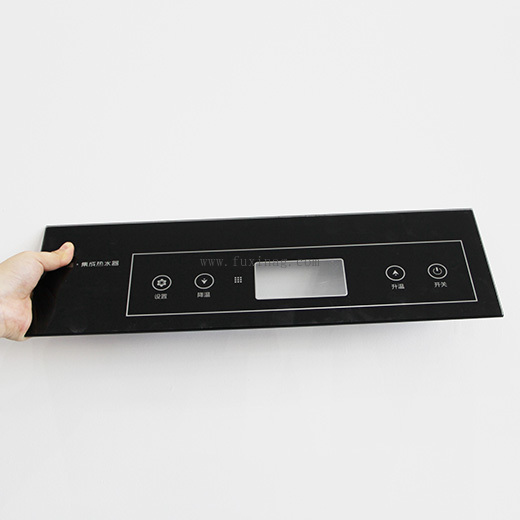
Founded in 2012, registered capital $1.5 million & 21000+m² plant, Fuxin Glass is an ODM/OEM provider for glass deep-processing service over 13 years, accumulating rich industry experience. We process base glass into customized cover glass with AG/AR/AF/AM surface coating and silk screen printing for touch screen, smart control devices, home appliances, lighting, and other special optical applications.
Our factory is near the beautiful Wanlv Lake, Heyuan City, China. The factory boasts a comprehensive suite of precision glass processing equipment, including glass tempering lines, fully automatic CNC cutting and edging lines, a large-scale screen printing line, linear and custom-shaped edging machines, and AG, AF, AR, and Anti-bacterial glass spraying. Leveraging a strong R&D and sales team, production capacity, and a stable supply chain, Fuxin Glass has grown to become one of China's top 3 electronic and electrical cover glass manufacturers and enjoys a global reputation.
We maintain stable partnerships with many renowned global brands, including TCL, HKC, CVTE, OKV, HUAWEI, KONKA, SEEWO. The company has a team of over 50 leading professional technical personnel. Based on the enterprising thinking of building a business with integrity, creating a new future, technological creativity and leading by science and technology, we are constantly innovating. We always adhere to the principle of "integrity, quality and win-win" and are willing to establish good long-term cooperative relationships with customers all over the world!
Fuxin Glass will give you quality and service that goes far beyond anyone else